

Does anyone have a photo of the 19 with the back covers off? I have been puzzled by the large size of the upper cabinet, yet can find no through connection to the lower cabinet on the drawings.


Excellent! Thanks Earl.
From the plans, it looks like ~5.75 cubic feet in the bottom box and about 2.3 ft in the top section. Are they connected?

Does anyone have a photo of the 19 with the back covers off? I have been puzzled by the large size of the upper cabinet, yet can find no through connection to the lower cabinet on the drawings.

Yes, Top & Bottom ( chambers ) are connected .Originally Posted by Mike
Here are Gary Ls' ( Gamalot ) custom M19 builds .
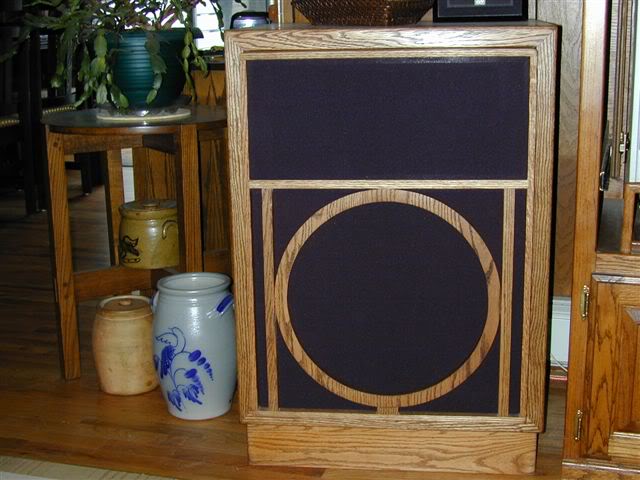
>< cheers

Interesting, thanks! I must have misread one or more dims on the barely readable set. I now get ~8.353487847 ft^3. Got to go change all my sims now.
GM
Loud is Beautiful if it's Clean! As always though, the usual disclaimers apply to this post's contents.
IIRC, the only access is through the horn, woofer cutouts and there's a large cutout connecting the two acoustically.
GM
Loud is Beautiful if it's Clean! As always though, the usual disclaimers apply to this post's contents.
Hi GM.
I couldn't find the cut out you are referring to on the plans. Are you certain the cabinets form one big enclosure? It makes sense.
Pretty certain, but then I was 'certain' I figured its net Vb right too.It's on the plans though, 21" x 10" beginning ~4.5" o.d. from the back, but you can see for yourself assuming GS didn't DIY some
: ALTEC pictures by gregorskiff - Photobucket
GM
Loud is Beautiful if it's Clean! As always though, the usual disclaimers apply to this post's contents.

Interesting GM, I would have thought that the two assemblies were separate.. Obviously with the horn part being stuffed, and by taking advantage of that additional volume it was needed for the LF driver?, maybe also to keep the cab size from being even bigger? So in reality if someone wanted to go a bit bigger for the LF driver cabinet, the HF part wouldn't matter for that method anymore?
Correct.
??? You can configure it however you want. All that matters is that the driver needs to 'feel' 'X' amount of air spring for a given tuning and response roll-off.
That said, as the bass bin's aspect ratio moves past a golden or acoustic ratio, the Helmholtz resonance theory begins to break down as it assumes the cab's air mass spring has a ~uniform particle density where the driver and vent location makes no audible difference, so as the aspect ratio increases we begin to see some 1/4 WL TL action in its long dimension and at some point they become strong enough to impact both vent damping and the cab's mid-band response, AKA tower, column and now MLTL, alignments.
So from this we see that at some point the length becomes long enough for the driver's and vent's location in the cab to be a tuning and response shaping choice and why a typical box design program that is based solely on Helmholtz resonance theory can't accurately sim this type of design.
GM
Loud is Beautiful if it's Clean! As always though, the usual disclaimers apply to this post's contents.

The horn section & woofer section connect as so in the picture. Two long bolts on either side. You can just see one of the bolt heads on the left in first pic, nut is at bottom.
 Posting Permissions
Bookmarks